Nano vs Micro vs Macro Influencers: Which Fits Your Budget
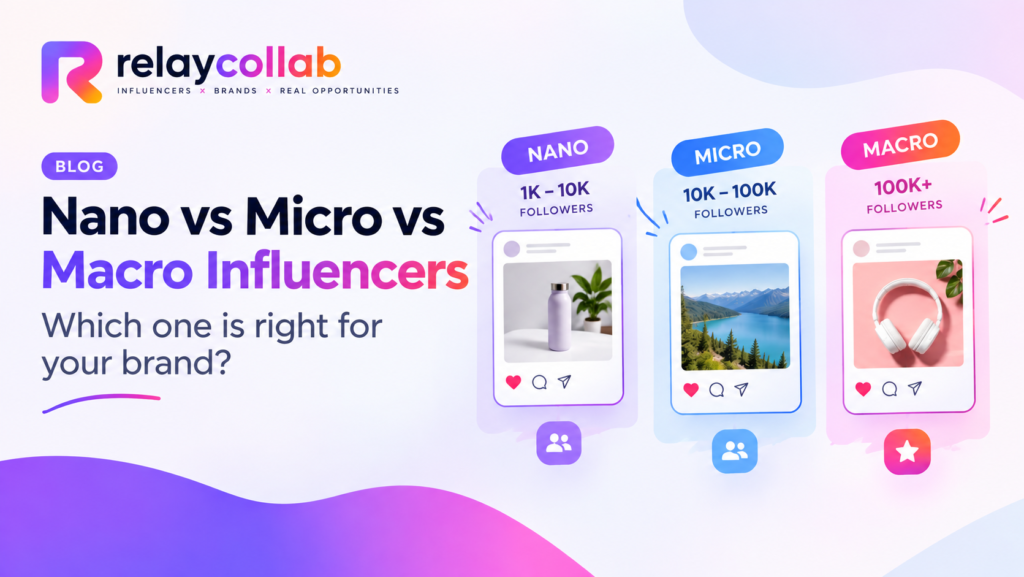
Every brand asks the same question, at every budget
Whether someone’s working with ₹50,000 for a festive push or ₹50 lakh for a full quarter, the question that comes up first is almost always the same one: should this go to one big name, or spread across a bunch of smaller creators? Most of the advice out there doesn’t actually help, because it’s written for a brand with a marketing team and a media-buying agency, not for the founder juggling this between ten other things.
So here’s the version without the jargon — what nano, micro, macro and mega actually mean, what each one really costs in India right now, and a way to think about splitting a budget that isn’t just “go with your gut.”
The five tiers, in plain terms
Follower count alone doesn’t tell you much — a 15,000-follower food page in Indore and a 15,000-follower fashion page in Mumbai behave completely differently. But it’s still the starting filter everyone uses, so let’s get it out of the way first.
| Tier | Followers | Typical engagement | Cost for one Reel* | Best for |
|---|---|---|---|---|
| Nano | Under 10K | 2–6% | ₹1,000–₹10,000 | Trust, local reach, testing |
| Micro | 10K–100K | 1.5–4% | ₹8,000–₹75,000 | Conversions, niche fit |
| Mid-tier | 100K–500K | 0.9–2% | ₹50,000–₹3,50,000 | Balanced reach + credibility |
| Macro | 500K–1M | 0.6–1.4% | ₹1,50,000–₹8,00,000 | Launch-day visibility |
| Mega | 1M+ | 0.4–1% | ₹6,00,000+ | Mass awareness, PR moments |
*Rough India ranges for a single Instagram Reel with basic usage rights, compiled from 2026 industry rate guides — actual quotes swing a lot by niche and content quality. Prefer to check a specific creator’s size against these ranges yourself? Our Influencer Rate Calculator does the maths for any follower count in between.
What each tier is actually good at
The table above is the quick version. Here’s what actually plays out when you work with each one.
10K
Nano influencers
Think of the home baker in Nagpur with 4,000 followers who genuinely tries every product she posts about, or the college student in Kochi reviewing budget skincare between classes. Their audience isn’t huge, but it’s real — mostly friends, neighbours, and people who found them through one specific post that actually helped. Because there’s so little distance between the creator and the follower, recommendations land like advice from a friend rather than an ad. The trade-off is obvious: reach is small, and managing twenty nano creators takes real coordination time. This tier works best for hyperlocal pushes, category entry (getting a first wave of honest reviews before a bigger spend), or when the budget genuinely can’t stretch further.
Best for: trust, local reach, testing a product100K
Micro influencers
This is where a creator has usually figured out their niche properly — a specific city’s food scene, a particular skin type, a genre of gaming — and built an audience that showed up on purpose, not by accident. Engagement is still meaningfully higher than the bigger tiers, but there’s now enough scale that a single post can move real numbers: a discount code getting used, a product selling out a batch. Most performance marketers we talk to treat this as the workhorse tier — not the most exciting name to put in a deck, but the one that actually shows up in the sales report. It’s also where RelayCollab sees the most listings, simply because it’s the size where “set your own rate and let brands come to you” works best for both sides.
Best for: conversions, niche audiences, repeatable ROI500K
Mid-tier influencers
Mid-tier creators have usually been at this for a few years — enough time to build a recognisable style, a loyal comment section, and often a small team helping with editing or brand deals. They’re big enough that a brand’s name means something for people to see them wear or use it, but still small enough to have a real back-and-forth in the DMs with a chunk of their audience. Brands often skip this tier entirely, jumping straight from micro to macro, mostly because it doesn’t have as neat a label as “influencer” or “celebrity.” That’s actually the opportunity — less competition for their attention, and rates that haven’t caught up to the reach they deliver.
Best for: credibility with reach, without celebrity pricingNot sure what tier fits your budget?
Plug in a number and see how many creators of each size it actually buys — plus a rough reach estimate.
1M
Macro influencers
By this size, a creator’s content usually looks noticeably more produced — proper lighting, tighter editing, sometimes a small crew. Engagement rates drop compared to smaller tiers, which is just maths: it’s genuinely harder to have a personal relationship with 800,000 people than with 8,000. But for a specific job — a launch day, a big sale, a moment where a brand needs a lot of eyeballs in a short window — nothing beats the sheer speed of a macro creator’s reach. The rates get serious here too, so this is usually the tier where a brand wants to be very clear upfront about what they’re getting: is this one Reel, a Story set as well, any usage rights for running it as an ad later? All of that changes the number a lot.
Best for: launch-day visibility, big awareness pushesMega influencers & celebrities
This tier includes both creators who built a following of a million-plus purely online, and actual celebrities who happen to also post on Instagram. Either way, the deal usually goes through a manager or agency, the rate is closer to a negotiation than a rate card, and the value is mostly about the halo effect — being seen next to someone recognisable — more than any specific number you can point to afterwards. It’s the right call for a genuine cultural moment: a big product launch, a brand wanting to signal “we’ve arrived,” a PR story that needs a recognisable face attached to it. It is almost never the right call for a brand trying to make its first ₹2 lakh of influencer spend work hard.
Best for: mass awareness, PR moments, brand prestigeSo how should you actually split the budget?
Every agency deck has its own version of this split, and they don’t fully agree with each other — some say 60% micro, some say 50/30/20, some break it into four buckets. Rather than hand you one more “magic percentage” to follow blindly, here’s the shape that most of that advice actually agrees on once you strip the branding off it:
Treat that as a starting shape, not a rule. What actually should change it is your own budget size and your goal, not a percentage someone else picked:
- Under ₹2 lakh: stay almost entirely in nano and micro. A single macro creator can eat the whole budget in one post, and you’ll learn far less than you would from ten smaller creators trying different angles.
- ₹2 lakh–₹10 lakh: mostly micro, with one or two mid-tier creators as anchors. This is usually the sweet spot where a brand can actually run a proper always-on program instead of a one-off campaign.
- ₹10 lakh and up: this is where mixing in macro (and occasionally mega, for a real launch moment) starts to make sense — but the micro layer underneath shouldn’t disappear, since it’s usually still doing the heavier lifting on actual conversions.
If you want to see this in rupees rather than percentages, our free Influencer Campaign Budget Calculator will show you, for your exact budget, how many creators of each size it buys and a rough reach range — it’s built on the same rate data as the table above, so the numbers stay consistent.
A quick way to decide, if you’re still stuck
When in doubt, work backwards from what you’re actually trying to achieve this month:
- “I need people to trust a new product” → nano and micro, and lean into honest, unscripted-feeling content over polish.
- “I need sales this week, not just views” → micro, with a trackable code or link for each creator so you can actually see what’s working.
- “I’m launching something and need noise fast” → macro, timed tightly around the launch date.
- “I want to be the brand everyone’s talking about” → mega or celebrity, but budget for it properly — a half-hearted mega deal often lands worse than a well-run micro campaign.
Mistakes we keep seeing brands make
A few patterns come up again and again, regardless of budget size:
- Chasing follower count over engagement. A creator with 40,000 followers and 5% engagement is doing more work for you than one with 400,000 followers and 0.4%. Always check the engagement rate before the follower count — our free Engagement Rate Calculator takes thirty seconds if a creator hasn’t shared theirs.
- Ignoring regional and vernacular creators. A lot of budget still defaults to Hindi- or English-first, Mumbai/Delhi-based creators, while regional-language nano and micro creators in tier-2 and tier-3 cities often convert better for the exact audiences many D2C brands are trying to reach.
- Forgetting to ask about usage rights upfront. The quote for “post on their page” and the quote for “let us run this as a paid ad for 90 days” are two very different numbers — and it’s a much worse conversation to have after the content is already shot.
- Assuming an agency is the only safe way to do this. It isn’t. Plenty of brands now book creators directly — no agency margin sitting in the middle — once they have a clear enough picture of fair rates to negotiate confidently themselves.
What’s the actual difference between nano and micro influencers?
Mostly follower count and how personal the relationship feels — nano creators (under 10,000 followers) tend to know a meaningful chunk of their audience personally, while micro creators (10,000–100,000) have usually moved past that but still hold a tight niche and above-average engagement.
Is it better to use one macro influencer or several micro influencers?
It depends on the goal. For a fast reach spike — a launch day, a sale — one macro creator can outperform several micro creators simply on speed. For anything conversion-focused, several micro creators covering different niches or cities usually deliver more total engagement and better cost efficiency for the same spend.
How much should a small brand budget for influencer marketing?
There’s no universal number, but a common starting range for a small Indian D2C brand is somewhere around 8–15% of total marketing spend, weighted almost entirely toward nano and micro creators until there’s enough data to justify spending more on bigger names.
Do mega influencers still work, or is that budget wasted?
They still work, just for a narrower job than people assume. Mega influencers and celebrities are strong for awareness and PR moments — “everyone’s talking about this” — but they’re a poor fit for a brand mainly chasing direct sales on a limited budget, since the cost per actual conversion is usually far higher than smaller tiers.
Can I mix tiers in the same campaign?
Yes, and most well-run programs do exactly that — a mid-tier or macro creator for the initial reach, followed by a wave of micro and nano creators to build trust and drive the actual conversions over the following weeks.
Where RelayCollab fits into this
Whichever tier you land on, the actual booking process shouldn’t be the hard part. RelayCollab lists creators with their real rates upfront, across every tier from nano to macro, so you can filter by platform and niche and reach out directly — no agency taking a cut in the middle, and no back-and-forth just to find out what something costs.
Ready to build your creator mix?
Browse nano, micro and macro creators with rates already listed, or list your own profile if you’re a creator reading this.
