Influencer Collaboration Agreement in India: What to Put in Writing (Checklist + Copy-Paste Confirmation Message)
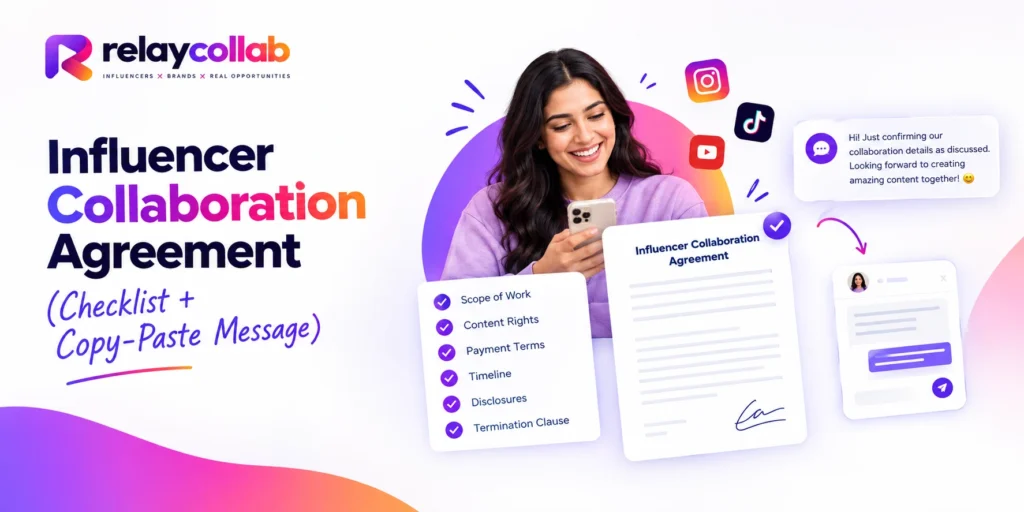
Two stories every creator in India has heard
A skincare brand DMs you on a Tuesday. You agree on a Reel over WhatsApp, voice notes and all. The Reel goes live. Then comes the line: “We’ll process payment next week.” Three weeks later you’re politely asking again.
Or this one. You agreed to “a Reel”. Two months on, you see the brand running your video as an ad. When you mention it, they say, “But you gave us the video, na?”
Neither of these started as a legal problem. They started as a clarity problem. Nobody wrote down what “a Reel” included, when the money was due, or how long the brand could use the video. When the details are scattered across forty chat messages and two voice notes, “I thought we agreed…” is all anyone has.
This post fixes that without a lawyer or a fifteen-page PDF. You’ll get the 12 things to put in writing, a builder that turns your answers into a message you can paste into WhatsApp or email, the India-specific points that most templates miss (they’re mostly written for the US), and a decoder for when a brand sends you its own contract.
For most single collaborations you don’t need a lawyer-drafted contract. You need the key terms written in one clear message that the brand replies “Confirmed” to, before you start work. In India, an agreement made over email or WhatsApp can be a valid contract if it has the basics: clear terms, agreement from both sides, and something given in exchange.
For bigger deals (paid ads, exclusivity, long ambassador terms, or a brand asking to own your content), get a proper signed agreement and have a lawyer read it.
This is general information, not legal advice. Laws and tax rules change and have edge cases, so check anything important with a lawyer or chartered accountant.
Is a WhatsApp or email agreement valid in India?
In principle, yes. Section 10A of India’s IT Act says a contract can’t be treated as unenforceable just because it was made electronically. The Indian legal sources we checked agree that email and WhatsApp exchanges can form a binding agreement, as long as the usual ingredients of a contract are there: an offer, an acceptance, something exchanged for value, and both sides freely agreeing.
But “can be valid” is not the same as “easy to prove”. If your agreement is a long chat where the terms are scattered, a voice note says one thing and the text says another, and the brand’s reply is a thumbs-up to a vague message, you’ll end up arguing about what was agreed. One clear message listing the terms, with a clear “Confirmed” in reply, is far stronger than forty messages.
One thing a chat can’t safely do is hand over ownership of your content. That has formal rules of its own, covered below.
The 12-point checklist: what to put in writing
For each item you’ll see the kind of sentence to write, and why it matters. Plain, specific sentences work better than legal language.
Who you’re dealing with
Write: “Collaboration between Glow Lab (contact: Rhea Kapoor) and Priya Sharma (@priya.glows).”
Deals go wrong when the person who agreed has left, or when it’s unclear whether an agency or the brand is paying. If you invoice, add legal names and GST/PAN details.
Exactly what you’ll deliver
Write: “1 Instagram Reel (30–45 sec) on my page + 3 Story frames with a link sticker.”
“A few posts” and “regular content” are how one Reel quietly becomes a Reel, six stories and a carousel.
The fee, and what it covers
Write: “₹12,000 for the deliverables above, plus 18% GST if applicable.”
Say whether GST is extra. Say what’s not included: extra edits, more posts, ad rights. Not sure what to charge? Use the Rate Calculator first.
When and how you get paid
Write: “50% advance to start, 50% within 7 days of going live, by UPI or bank transfer against my invoice.”
“After the campaign” and “once we process it” aren’t dates. Name a date or a trigger (going live), and say who raises the invoice.
The timeline
Write: “Product reaches me by 15 Oct, draft by 20 Oct, going live 25 Oct, stays up for at least 90 days.”
A late product or late feedback shouldn’t silently eat your calendar.
Approvals and revisions
Write: “Up to 2 rounds of changes; the brand replies within 2 working days.”
Unlimited revisions can turn a ₹12,000 Reel into a ₹4,000 one by the time you’ve finished.
How the brand can use your content
Write: “The brand may repost on its own Instagram and website for 90 days. Paid ads and whitelisting are not included.”
This is often the most valuable line in the deal. In our Rate Calculator, 90 days of paid-ads usage adds about 50% to the price, and 180 days about 90%. Ad-style videos for a brand’s own channels are priced separately, too: see the UGC Pricing Calculator.
Who owns the content
Write: “The content remains mine. The brand gets a licence for the use above only.”
Use the word “licence” (permission to use), not “rights”. Ownership has its own rules in India: see below.
Exclusivity
Write: “No paid posts for competing skincare brands for 30 days after going live.”
Exclusivity costs you other deals. If it’s there, it should be paid for, limited to a product category, and time-boxed.
Disclosure
Write: “I’ll label the post #Ad / Instagram’s paid partnership label. The brand approves the caption beforehand.”
The rules cover gifted posts as well as paid ones. Name the exact label and who adds it. Our templates guide has the label table.
What the brand provides
Write: “The brand sends the product, brief, link, discount code and mandatory tags by 15 Oct.”
A surprising number of late posts are late because the brief or the product was.
If something changes
Write: “If the brief changes or the shoot is cancelled after I’ve started, we’ll agree any extra fee in writing first. If payment is late, further use of the content waits until it’s received.”
Plans change. One line about it protects your time and your leverage.
Build your confirmation message
Answer the questions and the builder writes a message covering the points above, ready for WhatsApp or email. Nothing you type is stored or sent anywhere. It all happens in your browser. Anything you leave blank shows up as a [bracketed placeholder] so you can’t send it half-finished by accident.
Your terms
Fill in what you’ve agreed. Change anything in the message afterwards.
Your message
WhatsApp turns *this* into bold. Email gets a subject line and plain text.
Changing a field on the left rewrites this box, so make your own edits last. This is a plain-language confirmation of terms, not a legal document.
How it looks in the chat
India-specific points that most templates miss
Licence, not ownership
By default, you, the person who made the Reel, are its first owner. A brand paying you for a Reel doesn’t automatically own it. What the brand usually needs is a licence: permission to use the content in certain ways for a certain time. “Repost on our pages for 90 days” is a licence.
If a brand asks for ownership (“all rights”, “work for hire”, “assignment”), that’s a bigger thing. Under Section 19 of the Copyright Act, an assignment is valid only if it is in writing and signed, and it should name the rights, the duration and the territory. If the document stays silent, the law fills the gaps: five years for duration, and India only for territory. Those defaults can surprise both sides. A chat is not the place to settle ownership. Say “licence” in your messages, and if a brand wants to own your work, have a lawyer read the document and price it well above a normal Reel.
Money: fee, GST and TDS
Three practical lines, not tax advice:
- GST. If you’re GST-registered, influencer services attract 18% GST. The tax guides we checked put the mandatory registration threshold at ₹20 lakh of turnover (₹10 lakh in special-category states). Write “plus GST” or “inclusive of GST” in the fee line so nobody is surprised.
- TDS. Brands generally deduct TDS on payments to creators (commonly 10%), and on freebies above a yearly threshold. The guides we read disagree on the exact section and the ₹ threshold for fees, and the rules have been revised recently, so don’t hard-code a number. Write “TDS as applicable, certificate to be shared”, and ask your CA. One source notes TDS is normally calculated on the fee, not on the GST amount.
- Records. Keep your invoice, the TDS certificate, and check your Form 26AS / AIS when you file. For free products, see our barter collaboration guide.
Disclosure
Put the exact label in writing, and who adds it. The advertising rules apply to gifted posts as well as paid ones, and a hashtag that looks right isn’t always enough. The collaboration templates guide has the table of which labels work on their own and which don’t.
When the brand sends its own contract: a clause decoder
Brands, especially bigger ones and agencies, often send a template. It’s normal to read it carefully and ask for changes, and doing so makes you look more professional, not less. Here’s what common clauses can mean for you.
| You might see | What it can mean | What to ask for |
|---|---|---|
| “Perpetual, irrevocable, worldwide, all media” | The brand can use your content forever, anywhere, including as ads | Named platforms and a fixed period (for example 30 or 90 days) |
| “All rights assigned” / “work made for hire” | Ownership moves to the brand | A licence, not an assignment. If ownership is needed, a signed assignment with duration, territory and a much higher fee |
| “Exclusive for 6–12 months” | You can’t work with similar brands for that long | One product category, 15–30 days, and a fee that reflects it |
| “Payment within 60/90 days” or “after campaign results” | A long wait, or payment that depends on performance | A fixed date or trigger (going live), and part of the fee as an advance |
| “Unlimited revisions” | The work never finishes | A cap, such as two rounds, and a reply deadline |
| “Brand may edit or modify the content” | Edited versions could run under your name | Your approval of any edit before it’s published |
| “Creator indemnifies the brand” | You could be liable for the brand’s losses | Limit it to your own content being original, and have a lawyer read it |
| “Brand may cancel at any time without payment” | You could do the work and get nothing | Payment for work already done, or a kill fee |
General guide only. A clause’s effect depends on the whole document, so have a lawyer review any large or long agreement.
A message, or a full agreement?
A confirmation message is enough for many everyday deals. For others, spend the time (and a little money) on a proper signed agreement.
A confirmation message is enough when…
- It’s one post or a short series.
- The brand only reposts on its own pages, for 30–90 days.
- There’s no exclusivity, or only a short one.
- You could live with the worst case, losing this one fee.
Get a proper agreement when…
- The brand wants paid ads or whitelisting.
- There’s exclusivity, or a multi-month ambassador deal.
- The brand wants to own your content.
- The brand sends its own contract, or the amount really matters to you.
If the brand doesn’t pay
Having your terms in writing is what makes everything below easier. In order:
- A polite reminder that quotes your message. The amount, the date it was due, and the line you both confirmed. Attach the invoice.
- A firmer email with a deadline, usually seven days. Say what happens next if it passes.
- A legal notice through an advocate. Often enough on its own, because it shows you’re serious.
- The MSME payment rule, if it applies to you. If you’re registered on Udyam as a micro or small enterprise, the MSMED Act expects buyers to pay within 45 days and adds compound interest, at three times the RBI bank rate, to delays. There’s an online route for delayed-payment complaints.
If you’re the brand: send this first
Creators deliver faster and trust you more when the terms are clear from the start. So don’t wait for them to ask. Once you’ve agreed a deal, send a short message with the same twelve points, including your payment date, what you’ll provide and how long you’ll use the content, and ask them to reply “Confirmed”. It protects you as much as them.
To plan a budget, try the Campaign Budget Calculator. To find creators, browse Instagram creators with their rates listed, or list your brand on RelayCollab. If you’re a creator working out your own numbers, our guide to nano vs micro vs macro influencer rates is a good starting point.
Frequently asked questions
Do influencers need a contract in India?
Not by law for every deal, but you do need your terms in writing. A clear confirmation message can work for simple collaborations. For anything involving paid ads, exclusivity, long terms or a brand owning your content, use a proper signed agreement. A transfer of copyright ownership, in particular, has to be in writing and signed.
Is a WhatsApp or email agreement legally valid in India?
It can be. Section 10A of the IT Act says a contract isn’t unenforceable just because it’s electronic, and the usual ingredients still apply: an offer, an acceptance, something exchanged for value, and free consent. Make the terms clear in one message and get a clear “Confirmed”, because scattered chats are hard to prove. Use the builder above.
What should an influencer agreement include?
Who the parties are, exact deliverables, the fee and GST, payment dates and method, the timeline, approvals and revisions, how long and where the brand can use the content, who owns it, exclusivity, the disclosure label, what the brand provides, and what happens if plans change or payment is late. That’s the 12-point checklist above.
Who owns the content I make for a brand?
By default, the creator is the first owner. The brand usually only needs a licence to use it. If a brand wants ownership, Section 19 of the Copyright Act requires an assignment to be in writing and signed, naming the rights, duration and territory. If duration isn’t stated the law assumes five years, and if territory isn’t stated, India only.
How long can a brand use my content?
As long as you agreed, so write it down. Short licences of 30 to 90 days are common for reposts and ads. In our Rate Calculator, longer ad usage costs more: about +20% for 30 days, +50% for 90 days and +90% for 180 days on top of the post’s price.
Can a brand run my Reel as an ad without asking?
Only if your agreement allows it. If paid ads weren’t agreed in writing, treat it as outside the deal: write to the brand, ask them to stop or agree a fee for ad usage, and speak to a lawyer if they refuse. That’s exactly why the usage line matters.
What if the brand doesn’t pay?
Start with a polite written reminder quoting your confirmed terms, then a firmer email with a deadline, then a legal notice through an advocate. If you’re Udyam-registered as a micro or small enterprise, the MSME 45-day payment rule may also help, but only if you were registered before the deal. Check the details with a CA. See the steps above.
Should I sign a brand’s contract without reading it?
No. Read it and use the clause decoder. Asking for changes is normal. Do it in writing and keep the replies. For large or long agreements, have a lawyer read it first.
Do I need a separate agreement for a barter collaboration?
The same twelve points apply, with the product’s value and delivery date added. Free products can count as income, so keep a record. See our guide on whether a barter deal is worth it.
Do I need to charge GST?
If you’re GST-registered, 18% GST applies to influencer services. Registration is mandatory above ₹20 lakh of turnover (₹10 lakh in special-category states), according to the tax guides we checked. Say clearly whether your fee is plus GST or inclusive of it. Confirm your own position with a CA.
Know your rate. Get it in writing.
Work out what to charge, then list your profile so brands see your rates before they send the DM.
